Campervan awnings
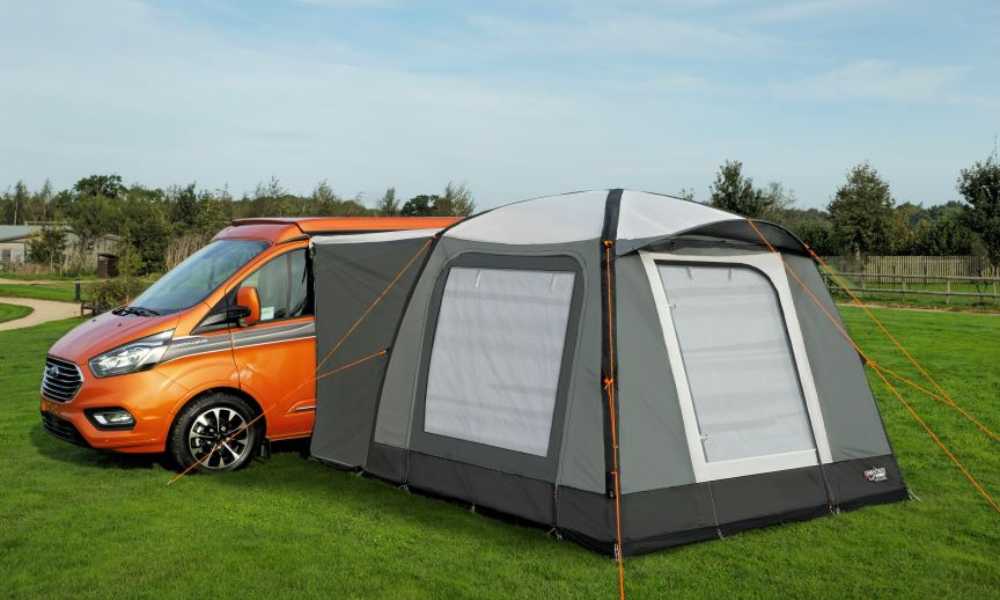
Your complete guide to campervan awnings
Discover the difference between cassette, inflatable, and drive away awnings
Campervans offer a great combination of essential comforts and the flexibility of easy parking, manoeuvrability, and a driving experience similar to that of a large people carrier.
Depending on your campervan model, a standard class IV MOT keeps you legal, roof-rack access doesn’t need a ladder, you have pop-up roof options, and you won’t have to worry about lane width restrictions caused by roadworks as you would do in a large motorhome.
However, the right campervan awning can transform your ownership experience.
Depending on your needs, an awning provides:
- Flexibility — travel light during everyday use and take the awning when you need it
- Storage — free up space inside your van when you camp
- Living space — chill, relax and spread out with more seating and dining space
- Sleeping space — extra or more flexible sleeping space for friends and family
This article explains the main campervan awning options, including type, construction, materials and use.
Cassette awnings
As the name suggests, a cassette awning is a long, slim case that fits along the edge of your campervan’s roofline. The awning sits inside the cassette and extends or retracts with a winch handle or remote-controlled electric motor. Some units include front corner poles that drop down as part of the cassette, while others store the poles separately.
It would be great if you purchased a campervan with a cassette awning. If not, aftermarket versions from manufacturers, including Thule and Fiamma, are available.
Cassette awnings are ideal for shade from the sun or light protection from rain. However, if you need to create an interior space, consider a driveaway awning:
Driveaway awnings
Driveaway awnings are similar to family tents, except they have a connecting panel that secures the awning to your campervan. The connection creates an interconnected space suitable for various uses. For example, you can use the awning for storage, leisure, dining or sleeping.
Yet when you need to drive off on a trip to the shops or a day out, detach the awning and the free-standing space stays put.
Driveaway awnings typically come in three sizes:
- Low or Lowline fits a campervan with an attachment height of 180-210cm
- Standard or Midline fits a high-roof camper or low motorhome with an attachment height of 205-245cm
- Tall or Highline awnings have an attachment height of 245-295cm to fit most motorhomes
Driveaway awning styles
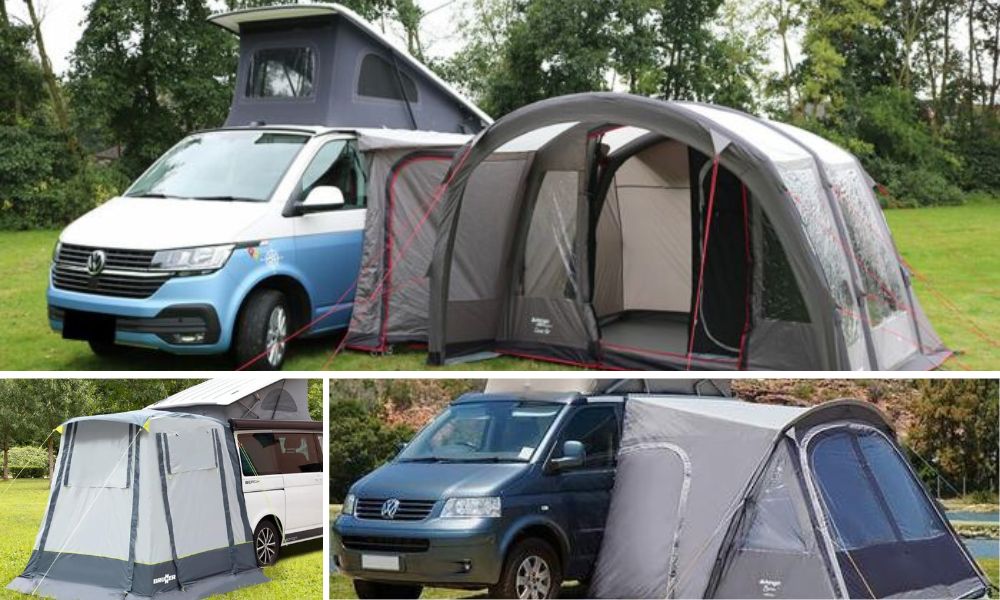
Front facing awnings
A front-facing awning faces straight out from the side of the vehicle. The front is at the opposite end of the vehicle’s side door.
Front-facing awnings are more compact than other awning types and are ideal if you have plenty of space around your camper. However, backing your van up to the rear of a pitch on a busy campsite means you may end up with the awning facing a neighbour.
Sideways facing awnings
Sideways awnings parallel the camper van, offering great space and options for partitions like sleeping pods. The other advantage is that the awning opens at the front of the camper, so the outlook is often better than the side.
Top Tip! Remember to buy an awning with the connecting panel on the same side of your opening camper door. Otherwise, the awning faces backwards.
Annexe or tail awnings
Tail awnings create a versatile, covered area at the vehicle’s rear. Some models have large access doors on both sides, which you can roll up to turn the awning into a gazebo in fair weather.
Should you choose a poled or inflatable awning?
Some driveaway awnings use fibreglass or steel poles to support the structure. Others use inflatable sections.
Inflatable awning manufacturers claim their products are faster and easier to pitch than a poled awning. However, plenty of evidence suggests that poled awnings are just as quick with some practice.
Poled awnings are also lighter, cost less to buy, and pack away into a smaller package. You’ll also need a 12v air pump to pitch an inflatable awning with minimal effort.
Polyester, polycotton or acrylic campervan awnings?
Awning fabrics vary significantly in weight, durability and price. The choice often comes down to how you plan to use the awning and your budget.
Polyester is a lightweight fabric that dries quickly after rain and packs away easily. It is water resistant but not waterproof; however, some products have an additional waterproof coating. 70-denier polyester is the lightest fabric, ideal for short-term camping trips in the summer.
150 Denier polyester provides more durability without adding too much weight.
Double Rip Stop 420-600 Denier Polyester is approximately 245% stronger than 70 Denier and ideal for camping early and late in the season.
Next is polycotton, or technical cotton fabric, which is naturally waterproof and adapts to hot and cold weather better than Polyester. Polycotton is also more durable, making it a better choice for longer trips away throughout the year.
Finally, we have heavy-duty, all-weather acrylic awnings at the top of the range. Acrylic is the most durable fabric, but it’s heavier and won’t pack down quite as tightly as Polyester. However, acrylic is popular for campers who want an awning to last several years.
Attaching your awning
Cassette awnings are permanently fixed to your campervan. Retro-fitted or aftermarket units have everything you need to install the awning. Still, we recommend hiring a professional to carry out the installation.
Driveaway awnings need an awning rail. Some awning rails are screwed directly to a C-channel if available. If not, you can buy a C-channel alternative that screws directly to the edge of the roofline.
You can also upgrade from a Cassette awning to a Driveaway awning with a kit that converts the 4mm Cassette channel to the 6mm needed.
Related Articles
How to winterise a motorhome
How to winterise a motorhome A practical guide on motorhome winterisation Winter can be harsh, and the thought of cold, damp, mildew, frost, and even animal infestation motivates owners to discover how to winterise a motorhome. This guide explains ...Motorhome breakdown
What to do and when you might need motorhome breakdown recovery Regardless of how well you maintain your vehicle, a motorhome breakdown will likely occur at some point. Yet, while the prospect may weigh on your mind, there are things you can do to ...Motorhome weight
What you need to know about motorhome weight How to stay safe and legal Motorhome weight doesn’t have to be confusing. And staying safe and legal is easier than you think. When you are new to motorhome ownership, there’s a lot of information to take ...Caravan toilet cassette
How to empty your caravan toilet cassette Discovering how to empty your caravan toilet cassette is one of the first things you’ll learn as a touring caravan owner. If you are pitching up on a campsite with the luxury of on-site toilets, there will ...Tyre pressures
A complete motorhome tyre pressure guide, including advice on tyre and wheel safety With the wheels keeping you moving and the rubber keeping you connected to the road, it helps to know how motorhome tyre pressures affect safety. Motorhome tyres have ...